

Introduction
In the first two parts of this series, I discussed why agentic development needs specification discipline and how SpecNexus provides a practical orchestration layer for turning mixed input into delivery-ready work. The next question is equally important for enterprise teams: how should this workflow be adopted responsibly?
For delivery managers, governance stakeholders, platform owners, enterprise architects, and Tech Leads, the challenge is not simply whether an AI-assisted workflow can move faster. The challenge is whether the workflow can move faster while decisions remain visible, ownership remains clear, and the team can explain why a change was approved.
This is where governance becomes useful. It is not a separate compliance exercise added after implementation. In an effective delivery model, governance is the set of practical controls that helps a team make the right decisions early, preserve them through delivery, and review the evidence before release.
Why governance matters
Agentic delivery can make implementation work start almost immediately. A product request, repository context, and a capable coding agent may be enough to produce a plausible pull request in a short time. That is useful, but it changes where delivery risk appears.
In a conventional workflow, uncertainty may become visible during analysis or handoff. In an agentic workflow, the same uncertainty can become code, tests, configuration, or deployment changes before the team has agreed on the underlying decision. The work may still look well formed. It may even pass a narrow test suite. The missing question is whether it represents the intended business rule, architectural boundary, security posture, and operational behavior.
Part 1 described specification discipline as the control layer between intent and implementation. At enterprise scale, governance gives that control layer an operating model. It answers practical questions such as:
- Who can confirm a material requirement or accept an unresolved assumption?
- Which models and execution environments are approved for a class of work?
- When should a team stop and ask for clarification rather than continue with an inference?
- What evidence is needed before a delivery slice can move to release approval?
These are delivery questions, not abstract AI questions. A manager needs a reliable status view. An architect needs important boundaries to remain visible. QA and security need to know what must be tested and reviewed. Governance is what connects those needs instead of asking each role to reconstruct the story from prompts, pull requests, and separate meeting notes.
The objective is not to make every change pass through a large committee. A small, low-risk copy update should not receive the same controls as a payment rule, identity change, or regulated data workflow. Good governance is proportionate: it applies enough structure for the risk and complexity of the work, while making exceptions explicit.
Where SpecNexus fits
SpecNexus sits between mixed source input and governed delivery execution. It receives the material that usually starts a feature: a product ticket, a meeting note, an issue, repository context, an architectural decision, or a security requirement. It then helps the team clarify material gaps, identify capabilities and constraints, select the appropriate output framework, and keep the delivery path visible through implementation, validation, and assurance.
The placement is important. SpecNexus does not replace OpenSpec or Spec Kit. It complements OpenSpec and Spec Kit by improving the quality of the input that reaches them and by orchestrating how the resulting work progresses through delivery. OpenSpec or Spec Kit remains the framework in which the specification is expressed. SpecNexus provides the governance and orchestration layer around that framework-native output.
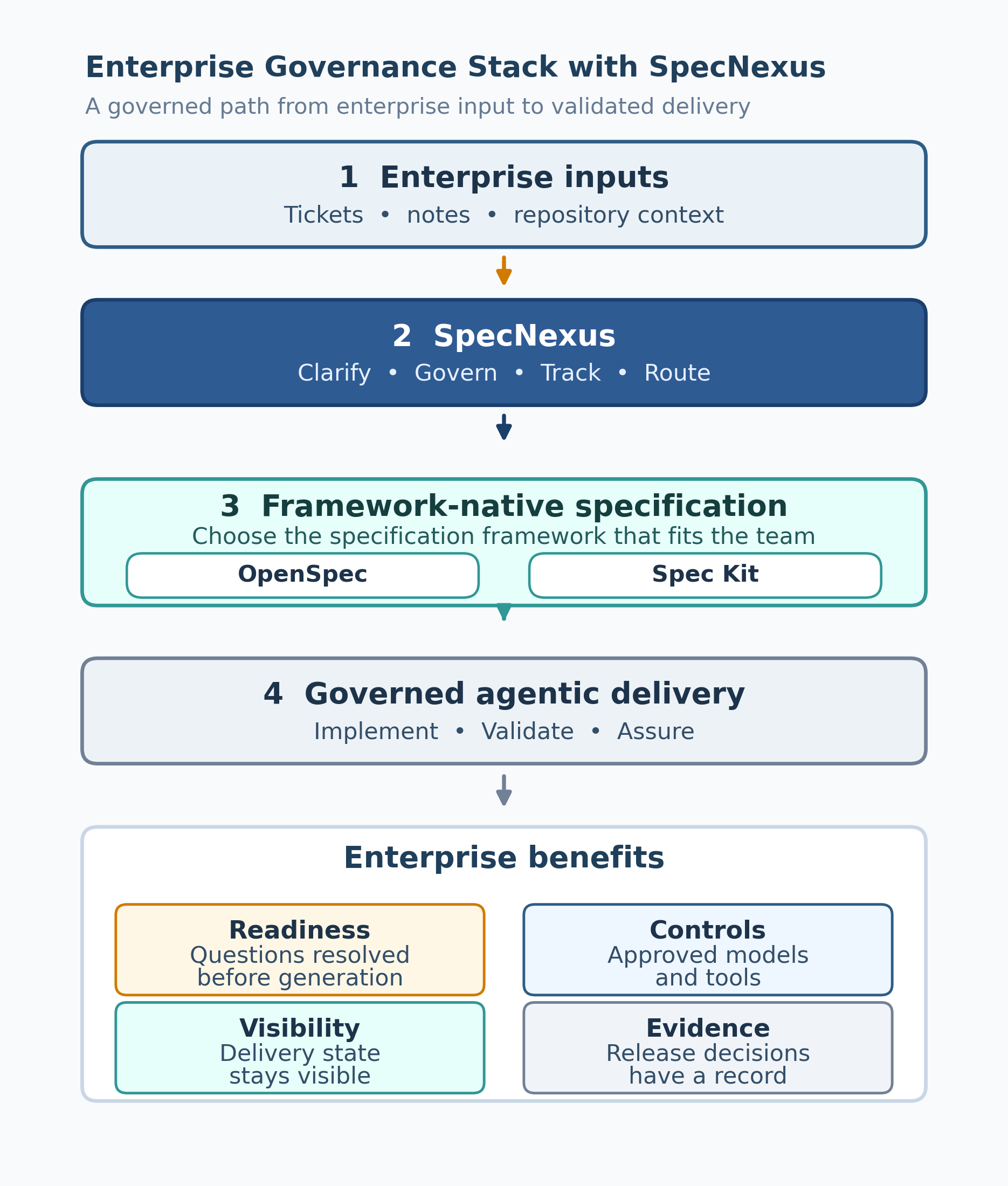
Figure 1: SpecNexus provides governance and orchestration around framework-native specifications and their delivery evidence.
This does not create a second competing specification format. A team that uses OpenSpec can continue to use its change-oriented proposal, design, tasks, and specification deltas. A team that uses Spec Kit can continue to use its specify, clarify, plan, research, and task flow. In both cases, SpecNexus helps make the input, decisions, delivery slices, checks, and evidence more consistent.
In practical terms, that means a platform owner can standardize the control points across teams without forcing every team to abandon the framework that already fits its delivery practice. The standard becomes the governed path, not a single document template.
The operating model
Governed agentic delivery works when responsibility is assigned before an issue reaches a release review. SpecNexus can make state and evidence visible, but it should not be treated as the owner of business or engineering decisions. Those decisions remain with the people accountable for them.
For a typical feature, the operating model can be kept simple:
- Product or business stakeholders own the intended outcome, priority, policy decisions, and acceptance of business behavior.
- Delivery managers own the delivery flow, readiness, dependency visibility, escalation of unanswered decisions, and the approval path.
- Architecture or platform governance owns approved patterns, framework guidance, model and environment policies, and exceptions that affect shared systems.
- Engineering teams own implementation choices within the agreed boundaries, repository conventions, technical assumptions, and changed-file evidence.
- QA owns validation strategy, scenario coverage, regression confidence, and the connection between acceptance criteria and test evidence.
- Security or DevSecOps stakeholders own the applicable security, privacy, operational, and deployment controls for the work.
The delivery manager is not expected to make every technical decision. Instead, the role makes sure a decision has a named owner and that a delivery phase does not move forward with a material question hidden in the work.
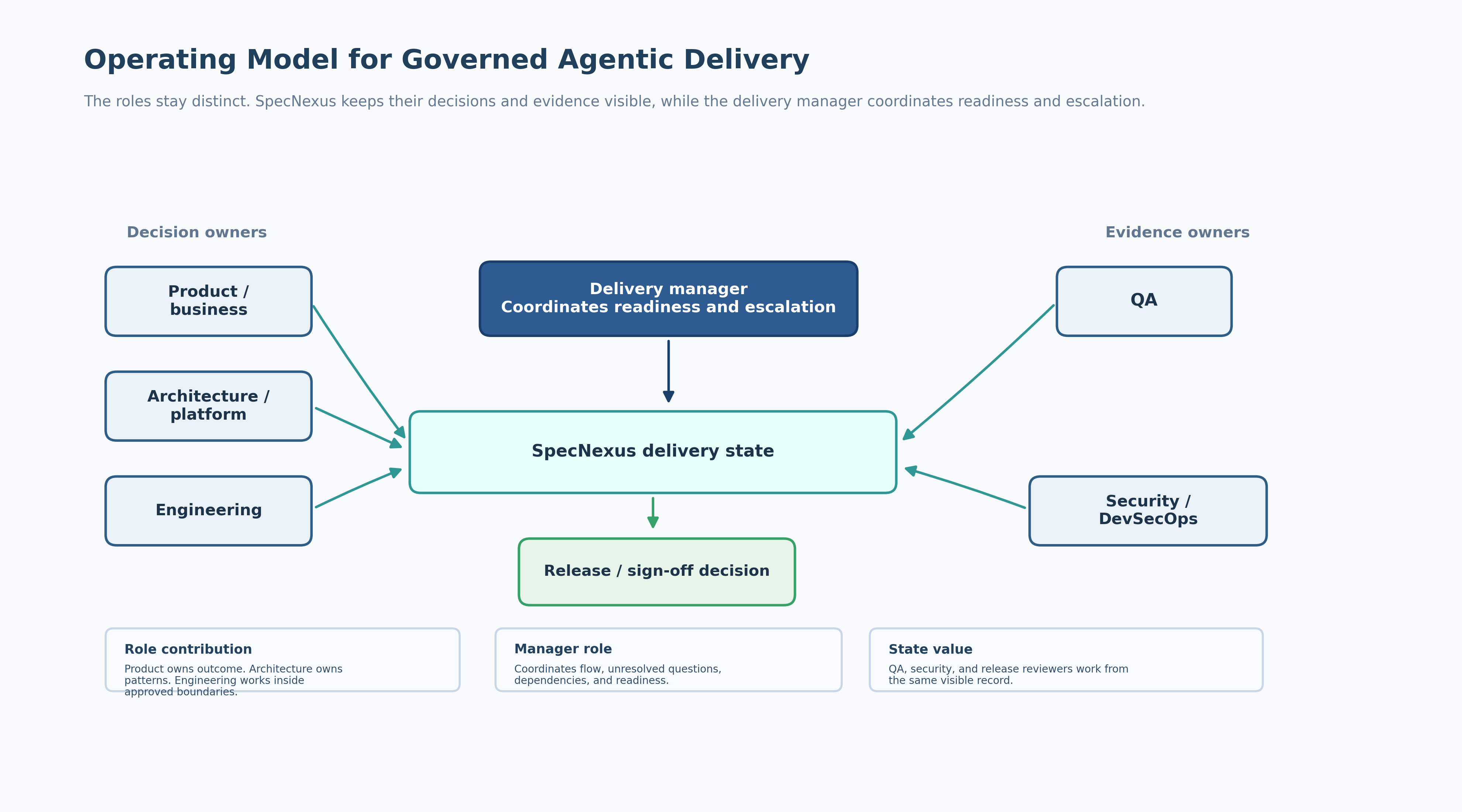
Figure 2: Each delivery role contributes a specific decision or evidence type, while SpecNexus keeps the resulting state visible.
This model also helps with handoffs. When a feature moves from definition to implementation, the engineering team should not have to search for the latest decision in a chat thread. When it moves to validation, QA should not have to infer acceptance behavior from a pull request. The relevant capability, slice, assumptions, approval state, and evidence should already be part of the delivery record.
Governance controls
The most useful controls are the ones that prevent a real delivery failure or make a review decision easier to defend. The following controls are a practical starting set.
Clarification gates
A clarification gate prevents a team or agent from treating a missing decision as a settled requirement. The gate should focus on material gaps: correctness, user-visible behavior, architecture, data handling, security, contracts, rollout, or test strategy. For example, an expense approval change may need a confirmed authorization boundary and audit requirement before implementation begins.
The goal is not to ask every possible question. It is to identify the few unanswered questions that would change the implementation or invalidate the result.
Approved model and environment selection
Model governance is often discussed at a policy level, but it has a direct delivery purpose. Teams should know which models, tools, repositories, and execution environments are approved for a given class of work. Where reproducibility or risk requires it, the selected model should be recorded or pinned.
This creates a visible boundary around how the specification or delivery artifact was generated. It also gives platform owners a place to manage approved options without expecting individual teams to make policy decisions every time they begin a feature.
Framework selection and specification ownership
The team should select OpenSpec or Spec Kit before framework-native artifacts are generated. That choice should follow the team or repository convention, not be silently inferred by an agent.
Again, SpecNexus complements OpenSpec and Spec Kit rather than replacing them. The framework captures the specification in its native structure. SpecNexus records the context, readiness, selection, and progression around it, so the downstream work remains traceable.
NFR and DevSecOps checks
Non-functional requirements are easy to lose when a feature is framed only as a user story. Availability, performance, privacy, auditability, accessibility, observability, and rollback may not be implementation details, but they affect implementation decisions.
For each relevant change, the team should identify which NFR and DevSecOps checks apply, who owns them, and what evidence will show they were addressed. A simple rule is useful here: if the requirement can be tested or inspected, connect it to a validation activity. If it cannot be measured yet, record the limitation and the decision owner.
Approval points, state transitions, and evidence
Every delivery phase does not need a formal meeting. It does need a clear transition rule. A capability can move from definition to implementation when material questions are resolved or explicitly accepted. A slice can move to assurance when its acceptance criteria, tests, changed files, and applicable NFR checks have evidence. A release decision can then be based on the evidence package rather than on confidence alone.
This is where an auditable state record becomes valuable. It can show what was intended, which decisions were made, what remains open, who approved an exception, which tests were run, and how the delivery status changed. That record is much more useful than trying to reconstruct the same information later from separate tools.
A phased rollout
The safest adoption path is incremental. Governance teams should first prove that the operating model works for a real type of delivery work, then extend it with evidence rather than assumptions.
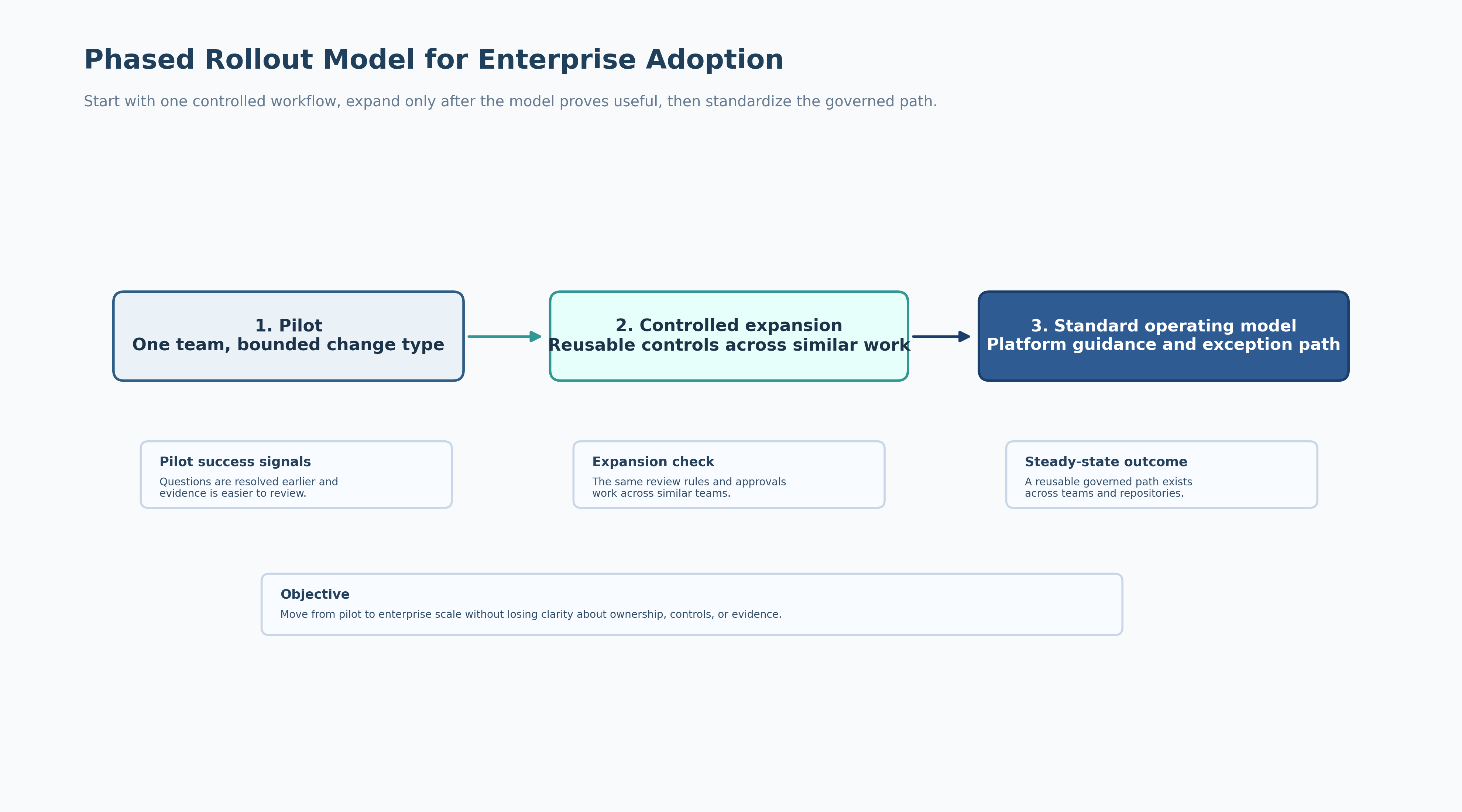
Figure 3: Adopt the governance model in stages so that controls and ownership are proven before organization-wide standardization.
1. Start with a controlled pilot
Select one team and a bounded, repeatable class of change. The pilot should be meaningful enough to exercise clarification, framework selection, validation, and assurance, but not so broad that every issue becomes an argument about policy. Define success criteria in advance. Useful measures include unresolved-question rate, review rework, evidence completeness, delivery lead time, and the number of manual exceptions needed.
2. Expand across similar workstreams
Once the first team has a working path, extend it to teams with comparable repositories, risk profiles, or delivery patterns. This is the right time to refine templates, approval boundaries, model policies, and evidence expectations. It is also the point where platform owners can identify which controls should be common and which should remain team-specific.
3. Establish a standard operating model
Organization-level adoption should provide a reusable operating pattern, not a rigid checklist that ignores context. Define the baseline controls, role responsibilities, supported frameworks, approved model options, exception route, and reporting view. Then review the operating model as teams learn from real delivery outcomes.
Common mistakes
The following adoption mistakes are common because they initially appear to make rollout easier.
Treating SpecNexus as a replacement for OpenSpec or Spec Kit
This creates unnecessary resistance and often duplicates artifacts. SpecNexus should be introduced as the governance and orchestration layer that complements the selected specification framework. The framework remains the place where the team expresses its specification.
Allowing uncontrolled model choice
Giving every project unrestricted model and tool choices makes it difficult to manage data, reproducibility, cost, and support expectations. Start with approved options and a visible exception route. The purpose is not to remove engineering choice; it is to make higher-risk choices deliberate.
Skipping clarification and validation gates to save time
This often moves the same work into rework, review churn, or late defect discovery. A focused clarification gate and a clear evidence expectation are normally smaller costs than correcting an unreviewed assumption after implementation.
Rolling out everywhere before proving the model
An organization-wide announcement is not an operating model. Start with a pilot, learn where ownership or controls are unclear, and extend only after the team can show a repeatable path.
Confusing governance with process overhead
Governance becomes overhead when it collects information that nobody uses or adds approvals that have no decision purpose. Keep each control connected to a risk, an owner, or an evidence need. If a control cannot answer one of those needs, simplify or remove it.
Governance checklist
Before extending governed agentic delivery to another team or workstream, use this checklist:
- The business outcome, scope, and decision owner are clear.
- Material assumptions have been resolved, documented, or explicitly accepted.
- The team has selected OpenSpec or Spec Kit as the framework-native specification format.
- The approved model, tools, repository access, and execution environment are known for the work.
- Architecture, platform, security, privacy, and NFR checks are identified where applicable.
- Each delivery slice has acceptance criteria, an implementation owner, and a validation approach.
- Validation evidence can be linked to requirements, slices, and relevant NFR checks.
- Approval points and exception owners are visible before release review.
- The delivery state records decisions, blockers, transitions, and sign-off evidence.
- The rollout has a bounded next step and a way to learn from exceptions and rework.
If a team cannot answer one of these items, that does not mean the work must stop indefinitely. It means there is a decision or risk that should be made visible before the team relies on generated output as a delivery commitment.
Bridge to Part 4
We have now moved from the reason for specification discipline in Part 1, through the SpecNexus workflow in Part 2, to the governance model that allows the workflow to scale responsibly. The important point is that governance does not replace engineering judgment or existing specification frameworks. It creates the conditions in which teams can use both consistently.
In Part 4, Hands-On Implementation Patterns with SpecNexus, we will move from the operating model to day-to-day delivery patterns: how teams can apply clarification, capability slicing, validation evidence, and assurance in practical implementation work.


