

Agentic development has changed the speed at which we can move from an idea to working code. A developer can describe a feature, ask an AI coding agent to explore a repository, generate an implementation, add tests, and propose a change in far less time than a traditional handoff would take.
That improvement is real. But the next question is more important: does faster code generation automatically give us better software delivery?
In most cases, it does not.
Software delivery is not only about producing code that compiles or even code that passes a narrow test. It is also about preserving intent, clarifying scope, protecting architectural boundaries, validating behavior, and ensuring that non-functional expectations are not lost between an idea and a deployed change. This is why specification discipline matters even more in agentic development.
Background: What Changes When Coding Agents Join the Delivery Loop
An AI coding agent is not simply another editor with autocomplete. It can inspect a codebase, make implementation choices, create files, connect services, and generate tests. In practical terms, it becomes an active participant in the implementation loop.
This changes the economics of execution. Work that previously took several rounds of manual navigation and boilerplate creation can now be attempted immediately. However, the agent still receives a representation of the problem, not the problem itself. It works from prompts, repository context, documents, issues, and the constraints that have been made visible.
Now the question arises: what happens when those inputs are incomplete?
The agent can still generate a plausible answer. In fact, that is what makes the problem easy to miss. The implementation may look reasonable in isolation while silently choosing a data rule, API behavior, authorization boundary, or error path that was never confirmed. Faster execution does not remove ambiguity. It can move ambiguity into the codebase faster.
Why a Good Prompt Is Not a Durable Engineering Contract
A good prompt is useful. It can give an agent a clear starting point, establish a local task, and guide the shape of an implementation. But a prompt is rarely a durable engineering contract.
Consider a feature request such as: “Allow managers to approve employee expenses.” A capable agent can create a screen, endpoint, service method, and tests. Yet the request leaves important questions unanswered:
- Which expense states can be approved, and which transitions are invalid?
- Can a manager approve their own expense?
- What must be recorded for audit and compliance purposes?
- Does approval create an integration event or trigger a payment workflow?
- Which roles can view the result, and what happens when the downstream system is unavailable?
- What performance, security, accessibility, and rollout expectations apply?
These are not minor details to be added after the code is written. They shape the behavior and structure of the feature. A prompt may mention some of them, but it does not normally provide the stable, reviewable, traceable form that a team needs as the work moves through implementation, QA, security review, and release.
For this reason, prompt quality is necessary but not sufficient for reliable AI software delivery. The team needs an artifact that separates confirmed requirements from assumptions, records constraints, and gives reviewers something more durable than a chat history to validate against.
Where Agentic Delivery Begins to Drift
Delivery drift starts when a broad intention is translated directly into generated work without enough structure in between. The chain is short, but each transition adds interpretation.
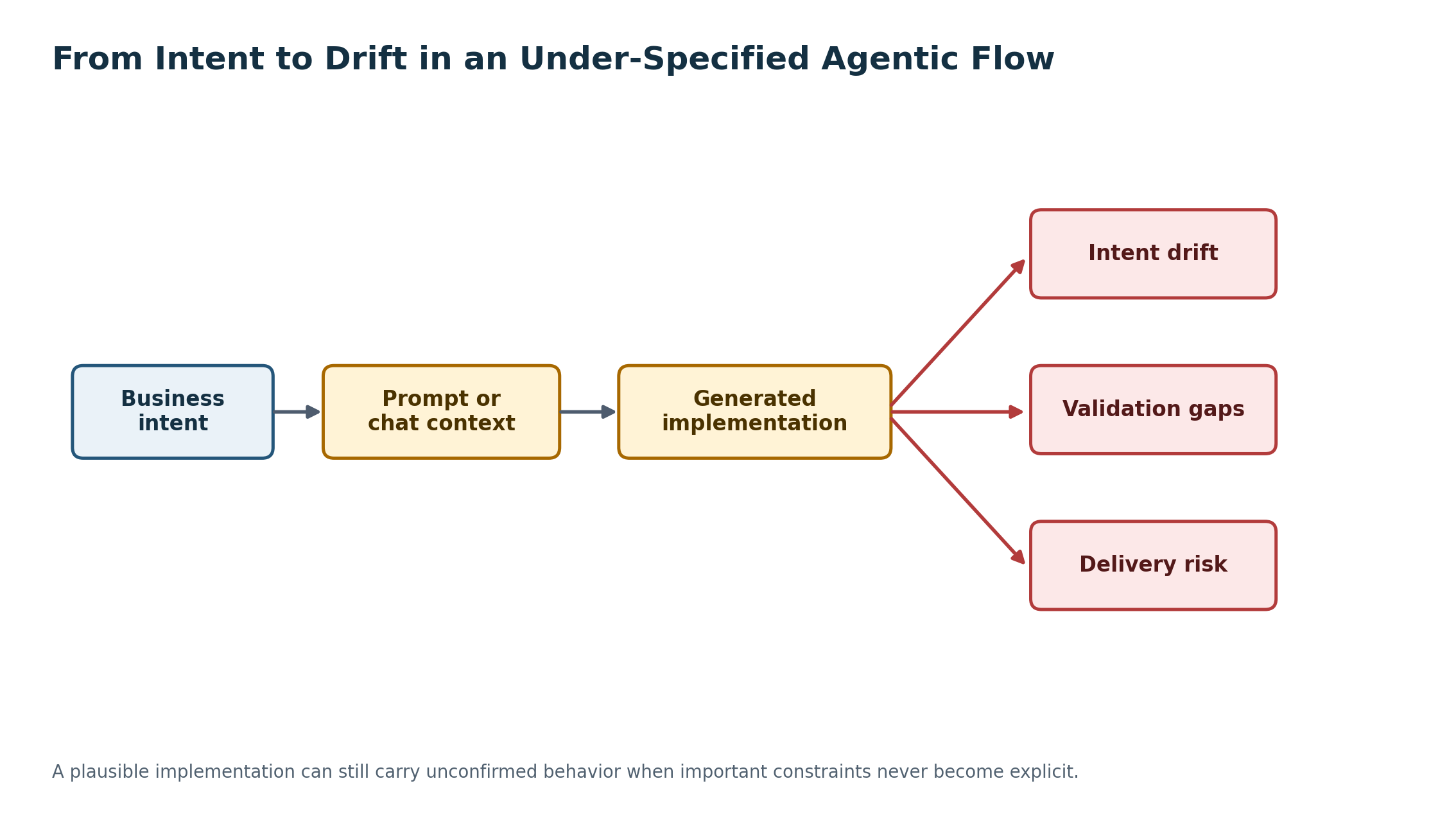
Figure 1: A direct path from intent to generated implementation can leave room for drift and unvalidated assumptions.
Drift does not mean that generated code is always wrong. More often, it means the code is correct for an assumption that nobody explicitly made. An agent may infer a default pagination rule, use an existing authorization pattern in the wrong context, or implement a happy path without the operational behavior needed in production.
There are several places where this becomes visible:
- Architecture: A local implementation can bypass a boundary that exists for consistency, tenancy, audit, or future integration.
- Contracts and data: An apparently simple field change can alter API compatibility, validation, retention, or migration requirements.
- Quality assurance: Generated tests often prove the behavior that was implemented, not necessarily the behavior the business expected.
- Security and operations: Authentication, authorization, observability, secrets, performance, and failure recovery are easy to omit when they are implicit.
- Release and ownership: A feature may need a rollout plan, feature flag, documentation change, or support handoff even when the code change itself is small.
The important point is that agents amplify both clarity and ambiguity. When the engineering intent is clear, an agent can accelerate useful work. When the intent is incomplete, the same speed can produce rework, review churn, and risk that is discovered too late.
Specification Discipline Is the Control Layer
Specification discipline is not a return to heavyweight documents written once and ignored. It is the practice of making the decisions that matter to delivery explicit enough to guide implementation and validation.
In an agentic workflow, it acts as a control layer between intent and generated work. It provides a structured place to capture what is known, identify what needs clarification, define capabilities, break the work into meaningful slices, and state how the result will be validated.
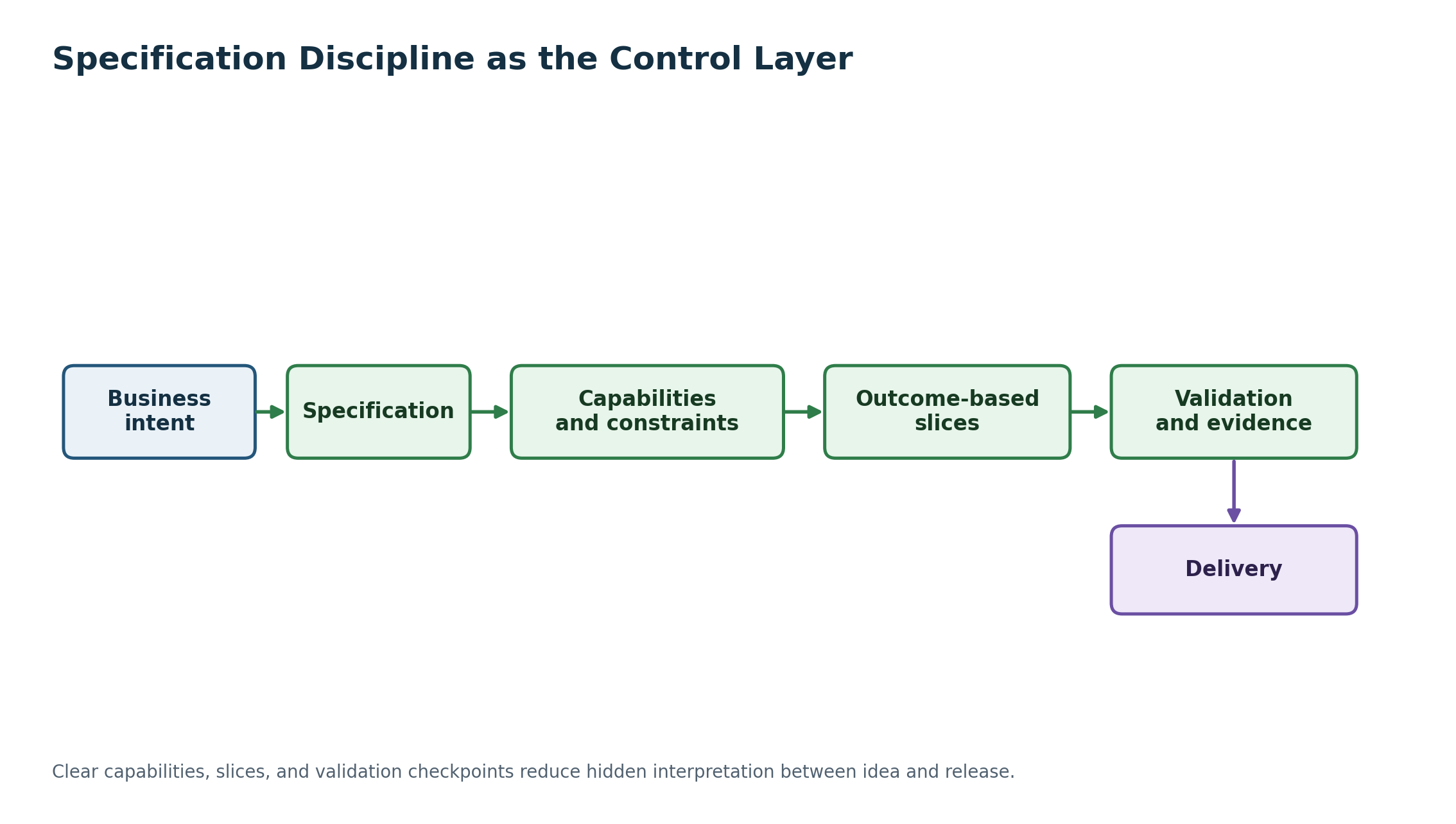
Figure 2: Specification discipline gives intent a reviewable path to delivery.
Let us make this practical. A useful specification does not need to predict every line of code. It should provide enough clarity for the team and the agent to make the next decision safely. At a minimum, that usually means:
- the problem and expected outcome;
- functional rules and acceptance criteria;
- architectural, data, contract, and security constraints that apply;
- explicit assumptions and unresolved questions;
- test scenarios, including important negative and boundary cases;
- delivery slices that can be implemented, reviewed, and verified as outcomes.
This structure changes the role of the prompt. Instead of asking the agent to infer the entire delivery model from a conversation, the prompt becomes one input into a governed workflow. The agent can still do the implementation work, but its output can be checked against capabilities, constraints, acceptance criteria, and validation evidence.
Why Architects and Developers Should Care
For architects, specification discipline protects the decisions that are easy to lose during rapid implementation. System boundaries, integration ownership, security posture, resiliency expectations, and non-functional requirements need to remain visible while an agent is producing code. A specification gives those decisions a place in the workflow before they become expensive production issues.
For developers, the same discipline reduces ambiguity and rework. It is easier to review an agent-generated change when there is a defined capability, a clear acceptance criterion, and an expected test scenario. It is also easier to extend the work later because the reason behind a decision is not trapped in a prompt from a previous session.
This does not reduce developer judgment. It makes that judgment more effective. The developer can spend less time reconstructing intent and more time validating design choices, implementation quality, and operational readiness.
There is also a team benefit. Product, architecture, engineering, QA, and security do not need to agree on every implementation detail at the start. They do need a shared way to make critical decisions visible, challenge assumptions early, and trace a delivered change back to its intended outcome.
A Practical Starting Point
Teams do not need to introduce a large process before they use AI coding agents. Start with a small discipline that is consistent:
- Write down the intended outcome before asking for implementation.
- Identify the constraints that would make a plausible implementation unacceptable.
- Record the questions that are still open instead of allowing the agent to answer them implicitly.
- Define how the behavior will be validated, including negative paths and relevant quality attributes.
- Review generated work against the specification, not only against whether it looks correct.
This is specification-driven development in a practical form. The goal is not more documentation for its own sake. The goal is less hidden interpretation between business intent and a released change.
Looking Ahead
Agentic development gives teams a powerful way to accelerate implementation. But speed only becomes a delivery advantage when the work remains connected to clear intent, explicit constraints, and credible validation.
That is the reason specification discipline is not an old process being carried into a new tooling era. It is the control layer that allows AI coding agents to participate in delivery without turning every generated change into a new set of assumptions.
In Part 2, I will look at how SpecNexus approaches this problem. The focus will be practical: how a workflow can clarify mixed-source input, define capabilities, create outcome-based slices, validate delivery, and keep the resulting work traceable without treating prompts as sufficient delivery artifacts.


